













Rome in June, a month of unmissable events and visit opportunities. Find out what to do from 1 to 30 June 2026 and follow the suggestions thought up by our editorial staff to experience and admire the city, including along less beaten paths.
-
Roma Live events in June
-
New entries and special events in June
-
Rome free/low cost in June
-
Rome with kids in June
-
The days of Rome: key dates in the city’s history and traditions in June
-
The many facets of Rome: places of the ancient Rome, papal Rome and modern Rome to (re)discover in June
-
Itineraries and curiosities: our tips for June
Roma Live events
Roma Live is the calendar for experiencing Rome at 360°, a multimedia container dedicated to unmissable events for those living in the city and for tourists. Check here all the events for the month of June, navigating among the exhibitions, sporting events, concerts, theater shows, festivals, ballets and dance performances scheduled until 30 June. Please note: information available in this section is being updated constantly.
New entries and special events
-
OperaCamion 2026 - From 31 May to 17 June, opera will once again take to the road aboard a lorry to take over the squares, courtyards and urban spaces of Rome with the latest edition of the Teatro dell’Opera’s travelling project. The quintessential opera buffa, Gioachino Rossini’s “The Barber of Seville” is presented in a version inspired by the circus, commedia dell’arte and street theatre, yet one that retains all the musical and theatrical richness of the original score.
-
Diego Rivera and the development of modern art in Mexico - A life brimming with passion – for politics, for art and for women. A titanic figure in 20th-century Mexican art, a staunch Marxist, and the lover and turbulent husband of Frida Kahlo (whom he married twice), Diego Rivera is the focus of the exhibition at the Capitoline Museums: from 9 June, over 160 works invite visitors to discover an artistic output that blends social commitment, cosmopolitanism and pre-Columbian traditions.
-
Roma Summer Fest 2026 - A program that spans genres, styles and generations, ranging from pop and rock to rap and singer-songwriter music. From 13 June (until mid-September), the Auditorium Parco della Musica Ennio Morricone is hosting once again one of the most eagerly awaited festivals of the Roman summer, bringing a long list of Italian and international artists to the city, including established names and new talents. Among the headliners in June are Mac DeMarco, Kneecap and Ben Harper.
Rome free/low cost
Churches, palaces and fountains, courtyards and cloisters, elegant squares and secret piazzas, marbles and stones with a history stretching back thousands of years – even if you have a limited budget, the city does not skimp on its wonders. With the new pricing system, access to museums and monuments managed by Roma Capitale is free for all residents of Rome and the metropolitan city. For tourists and non-residents, on 7 June, as on every first Sunday of the month, both the national cultural sites and the museums run by Roma Capitale will open their doors to the public free of charge. State museums and archaeological parks will be open free of charge (during their usual opening hours) on 2 June as well, to celebrate Republic Day. On 28 June, as on every last Sunday of the month, entry will be free to the Vatican Museums (from 9 a.m. to 2 p.m., last admission 12.30 p.m.). There are also four small museums that are always free for everyone (Museo delle Mura, Museo della Repubblica Romana e della Memoria Garibaldina and Museo di Casal de’ Pazzi, from Tuesday to Sunday, and the Casa Museo Alberto Moravia, open on the second Saturday of the month), plus the FAO MuNe - Food and Agriculture Museum and Network (from Monday to Friday, with mandatory online reservation), Palazzo Sciarra Colonna (from Wednesday to Sunday) and Casa Pasolini (from Thursday to Sunday). On the last Friday of every month, it is possible to visit the Farnesina collection of the Ministry of Foreign Affairs and International Cooperation.
Free or low cost events and activities for the month of June include for example: the Roma Pride 2026 (20 June), WEmbrace Games 2026. Play Wild at the Stadio dei Marmi (8 June), the programming of Officina Pigneto (every Thursday), La Tempesta silenziosa - The Silent Storm (a reading event conceived by Alessandro Baricco, 17 June) and Rome’s historic Infiorata in Via della Conciliazione (29 June); the film festivals (films in original version) Filmissimi - Il cinema tedesco d’autore at the Goethe-Institut (11 and 15 June), Cinemente. Rinascite (4, 11, 18, 25 June) at Palazzo Esposizioni (4, 11, 18, 25 June) and the open-air screenings of Cinema in piazza; the seasonal opening of the Municipal Rose Garden (until 14 June) and visits to the Japanese garden of the Japanese Cultural Institute (on Thursdays and Fridays), tours of the restoration site for the monumental halls of Palazzo Venezia (6 and 20 June), visits of Palazzo Borromeo (19 June), and the visits and special openings of Archeologia in Comune 2026 and the Malborghetto Arch; the exhibitions Acrobats, fire-eaters and funfairs at La Vaccheria, Borges. El oculto nombre de Roma at Casa Argentina, Francesca Woodman. Lately I Find a Sliver of Mirror Is Simply to Slice an Eyelid at the Gagosian Gallery, Danh Vo at the Nicola del Roscio Foundation, Federica Luzzi and Naoya Takahara. Exercises in being like others at Mattatoio Roma (from 4 June) and Mafalda & La Pimpa in the Sala Dalì at the Instituto Cervantes in Piazza Navona; the Georgetown Chorale concert in the academic hall of the Conservatorio di Santa Cecilia (11 June), the Solstice Concert at the Casa Madre dei Mutilati (21 June), performances by the Banda va in città and the organ concerts in the church of Sant’Antonio dei Portoghesi (6, 20 and 27 June). Find more tips on the cultureroma website.
Rome with kids
Museums to explore, educational workshops and readings, theme parks, theatrical performances and much more... Discover all the events dedicated to children scheduled for the month of June and unleash your imagination among surprising adventures, journeys through history, interactive itineraries and guided tours. Our Kids page is updated weekly: visit us again for new ideas!
The days of Rome: key dates in the city’s history and traditions
Rites, festivals, anniversaries and celebrations have always marked the life of the city, its inhabitants and its visitors: a dense calendar of fixed happenings dating back to past eras, but also to the present day, that define Rome’s identity. Discover with us some of the city’s old and new special dates and moments, with the most heartfelt or awaited occasions – or even simply the most curious ones for the month of June.
The many facets of Rome: places of the ancient Rome, papal Rome and modern Rome to (re)discover
The pagan Rome that was the center of one of the largest empires that ever existed; the symbol city of the Catholic religion shaped by the successors on the throne of Peter; the new capital of the Kingdom of Italy and then of the Republic. The history of an eternal city is inevitably made up of multiple narratives that intertwine with one another. Each month, we will introduce you to three places that show the different imagines of Rome through the centuries.
-
The sacred area of Sant’Omobono - “Go, good mothers (the Matralia is your festival)”. Celebrated every 11 June and reserved exclusively for women in their first marriage, the festival described by Ovid in the “Fasti” had its roots in Rome’s distant past. So much so that its rites – such as the symbolic whipping and expulsion from the temple of a slave-girl or the women taking in their arms their sisters’ children – seemed unusual even to the Romans themselves. After all, the Matralia honored Mater Matuta, an ancient Italic deity associated with the archaic cult of the Great Mother (and later identified with the Greek goddess Ino-Leucothea). Her temple was rediscovered in the 1930s on the edge of the Forum Boarium, in a sacred area dating back to the early 6th century BC where excavation has brought to light some of the earliest evidence for human presence on the site of Rome and of trade relations between the new city and the rest of the Mediterranean.
-
The Castle of Santa Severa - A castle overlooking the sea and a stretch of coastline with a millennia-long history, inhabited since Neolithic times. Some 50 kilometers separate Rome from the beach where the young Severa was martyred on 5 June 298: here, on the ruins of a Roman colony built on the Etruscan port of Pyrgi, a fortified village with a castle grew up in the Middle Ages, later rebuilt a few centuries later. Changing in response to needs, tastes and functions, the complex became one of the popes’ favorite places to stop and stay, reaching its peak of splendor in the 17th century. Now owned by the Lazio Region, the castle is hosting the “Vivi il Castello di Santa Severa 2026” festival from 1 June (and until 31 August), featuring a program of concerts, theatre, cinema, exhibitions and cultural events. On Saturdays, Sundays and public holidays, guided tours organized by LazioCrea take us on a journey of discovery.
-
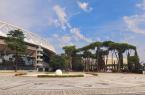
The Palazzo dello Sport - On 15 June 1955, Rome was officially selected by the International Olympic Committee to host the 1960 Olympics. For the city, it was the start of a countdown – four years to upgrade or build from scratch the sports facilities needed for the competitions. The key features of the new face the city would present to a global audience were the Flaminio district (where the Village for over 5,300 athletes would also be built) and the still-unfinished EUR district. Here, Marcello Piacentini and engineer Pier Luigi Nervi completed the view along Via Cristoforo Colombo with a spectacular cylinder of glass and steel, covered by a spherical dome composed of prefabricated concrete sections. Completed in just two years and inaugurated on 3 June 1960, in time to host the basketball and boxing competitions (with the young Cassius Clay winning Olympic gold), the Palazzo dello Sport remains the city’s largest indoor events venue to this day.
Itineraries and curiosities: our tips
-
Alberto Sordi’s Rome - A city described, experienced and loved with every fibre of his being, “a great museum, a drawing room to be traversed on tiptoe” yet without forgoing irony, that liberating and irreverent laughter, because “when you joke around, you need to be serious”, as he would say in the role of the Marquis of Grillo. Alberto Sordi’s long career ran parallel to the historical, social and economic transformations of Rome – the city where he was born on 15 June 1920, in the Rione Trastevere, and that would serve as the backdrop and co-star in over 56 of the actor’s films. Find out more in the dedicated page.
-
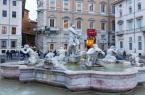
The Fountain of the ridiculous (or simply ugly) Moses - A colossal Moses stands frowning, pointing towards the waters miraculously gushing from the rock, whilst holding the Tablets of the Law in his hands, in complete defiance of any chronological consistency. It doesn’t take much for a nickname to catch on. A rather unsuccessful work by Leonardo Sormani and Prospero Antichi, the statue sealed the fate of the fountain’s name, which was hastily inaugurated on 15 June 1587 as the terminus of the Acqua Felice, one of the many urban projects launched by Sixtus V during the five frenetic years of his papacy. Find out more in the dedicated page.