

























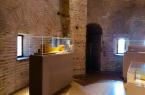



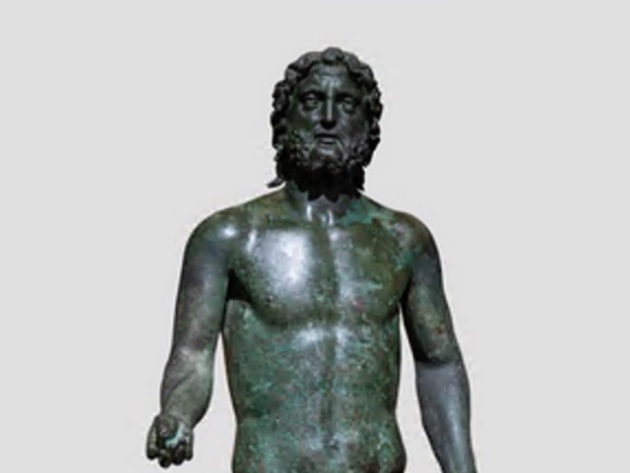
In the ground-floor hall of the Giovanni Barracco Museum of Ancient Sculpture, a hidden gem among Roman museums, the Neptune is on display, an exceptional loan from the Lugdunum-Musée et Théâtres romains in Lyon. This is a truly significant exhibition, the result of a significant international exchange, which brings to the Museum one of the most significant works from the ancient Roman colony of Lugdunum, now Lyon.
The Neptune of Lyon is one of the largest bronze statues from ancient Gaul, characterized by its adoption of a typically Greco-Roman iconography, free of the eclecticism so common in the sculpture and art of Roman provinces. At the same time, its stylistic and formal features reveal the nature of a work from a local workshop, not imported from Italy or Greece.The Neptune of Lyon is one of the largest bronze statues of ancient Gaul, characterized by its adoption of a typically Greco-Roman iconography, free of the eclecticism generally so common in the sculpture and art of Roman provinces. Created in the 3rd century AD by a local atelier, the almost life-size work depicts the god of the sea and waters emerging from the waves, identifiable by the arrangement of his hair curled in "wet curls". According to an iconography borrowed from his Greek counterpart Poseidon, it is thought that the deity originally carried a trident, his main attribute, in his left hand, and perhaps a dolphin in his right. His monumental home was likely a city temple in Lugdunum, the capital city of the province of Gallia Lugdunensis and the "metropolis" of Gaul.
Also significant is this god's role as protector and lord "of the waters", though not primarily of the sea as among the Greeks and Romans, but rather of inland, riverine waters. The location of its discovery is interesting in this regard: the statue was fished out of the Rhone in 1859, in the stretch where the river flows through the city of Lyon, almost as if to underscore the god's connection to the aquatic world of the rivers, a connection to be contextualized in the religiosity and cult dedicated to him in Celtic times.
The initiative, promoted by Rome City Council, the Department of Culture and the Coordination of Initiatives Related to Holocaust Remembrance Day, and the Capitoline Superintendency of Cultural Heritage, in collaboration with the Métropole Grand Lyon, is part of an agreement for the exchange of ancient works signed between the Giovanni Barracco Museum of Ancient Sculpture and the Lugdunum-Musée et Théâtres romains, Métropole de Lyon, on the occasion of the fiftieth anniversary of the latter's founding. At the same time, several masterpieces from the Barracco Museum are on display in the exhibition currently underway in Lyon, C'est canon. L'art chez les Romains.
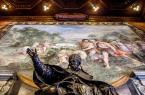
Photo: the Neptune of Lyon
Informationen
Dal 6 febbraio al 3 giugno 2026
Dal martedì alla domenica ore 10.00 - 18.00
Ultimo ingresso ore 17.15
Giorni di chiusura
Tutti i lunedì, 1° maggio
CONSULTA SEMPRE LA PAGINA AVVISI prima di programmare la tua visita al museo.
 Condividi