


















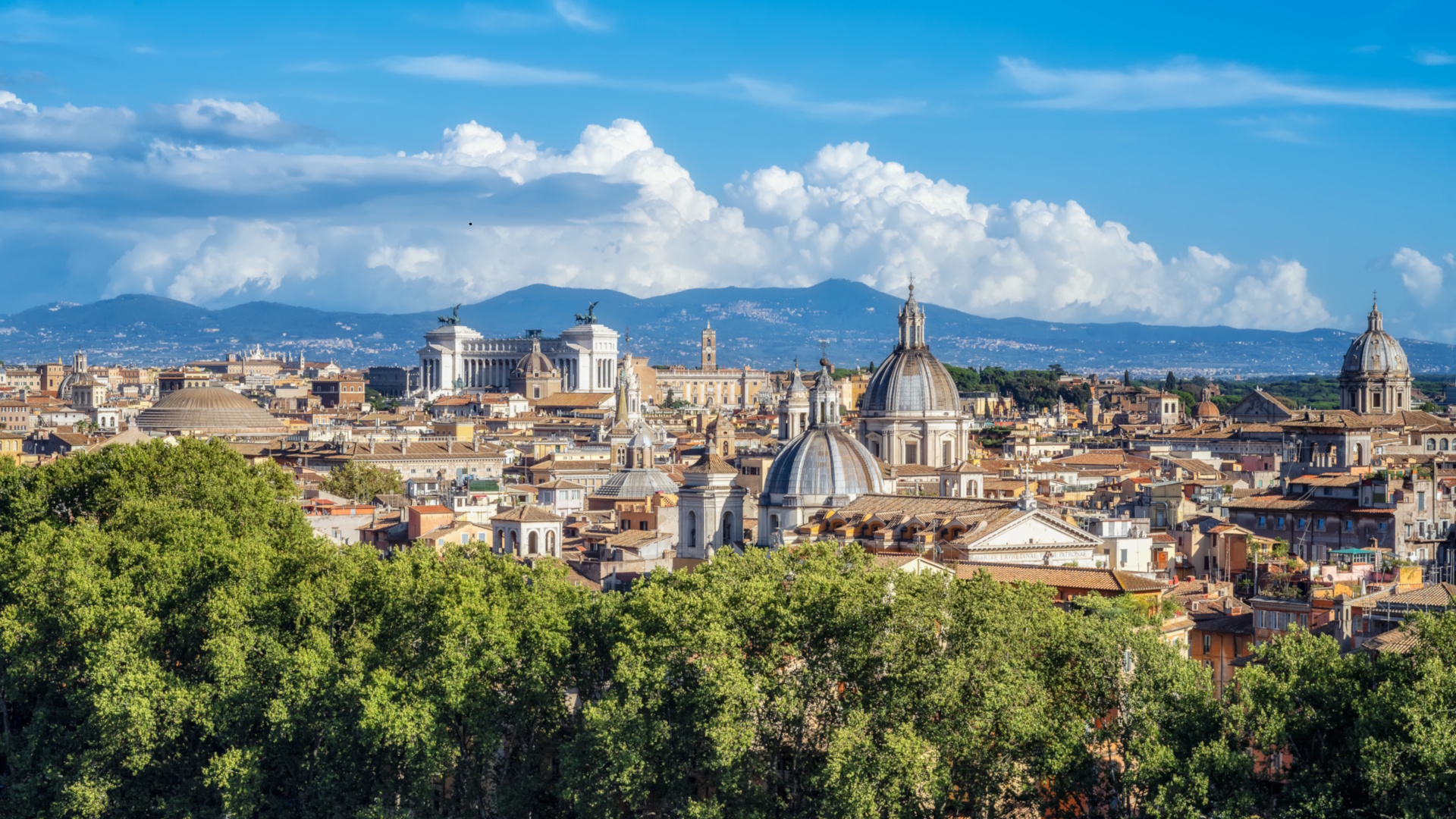
Rome in April, a month of unmissable events and visit opportunities. Find out what to do from 1 to 30 April 2026 and follow the suggestions thought up by our editorial staff to experience and admire the city, including along less beaten paths.
-
Roma Live events in April
-
New entries and special events in April
-
Rome free/low cost in April
-
Rome with kids in April
-
The days of Rome: key dates in the city’s history and traditions in April
-
The many facets of Rome: places of the ancient Rome, papal Rome and modern Rome to (re)discover in April
-
Itineraries and curiosities: our tips for April
Roma Live events
Roma Live is the calendar for experiencing Rome at 360°, a multimedia container dedicated to unmissable events for those living in the city and for tourists. Check here all the events for the month of April, navigating among the exhibitions, sporting events, concerts, theater shows, festivals, ballets and dance performances scheduled until 30 April. Please note: information available in this section is being updated constantly.
New entries and special events
-
Hokusai - The ever-changing and floating everyday world of one of the world’s most celebrated Eastern artists, whose vast body of work – comprising paintings, engravings, prints, and illustrations – has spanned the centuries, revolutionizing the Western imagination since the late 19th century. Starting from 27 March, landscape visions, great masterpieces, and extremely rare treasures on display at Palazzo Bonaparte will highlight the creative journey of the Japanese master of Ukiyo-e and Buddhist impermanence, Katsushika Hokusai.
-
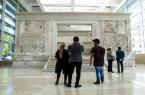
The Ara si rivela experience - Romulus and Remus with the she-wolf, Aeneas offering sacrifice to the Penates, the Goddess Roma, Augustus with his head veiled, followed by the imperial family and the priests, all dressed in the vivid colors of a Technicolor dream. Starting from 27 March, on Friday, Saturday, and Sunday evenings, a new multimedia project explain the millennia-old history of the Ara Pacis, the monument commissioned by Emperor Augustus and dedicated to peace, restoring the original polychromy to its marble.
-
Serata Preljocaj - “La Stravaganza”, “Annonciation”, “Noces”: featuring the étoiles, principal dancers, soloists, and the corps de ballet of the Teatro dell’Opera di Roma, from 14 to 19 April the Teatro Nazionale celebrates the Franco-Albanian choreographer Angelin Preljocaj and his forty-year career in the world of dance with three creations born of his imagination and drawn from his repertoire – an intense and surprising contemporary language combined with the perfection of classical technique.
Rome free/low cost
Churches, palaces and fountains, courtyards and cloisters, elegant squares and secret piazzas, marbles and stones with a history stretching back thousands of years – even if you have a limited budget, the city does not skimp on its wonders. With the new pricing system, access to museums and monuments managed by Roma Capitale is free for all residents of Rome and the metropolitan city. For tourists and non-residents, on 5 April, as on every first Sunday of the month, both the national cultural sites and the museums run by Roma Capitale will open their doors to the public free of charge. Admission to national sites and museums is exceptionally free on 25 April as well, to commemorate Liberation Day. Please note: in some cases, a reservation is required, so always check in advance the websites of the museums. On 26 April, as on every last Sunday of the month, entry will be free to the Vatican Museums (from 9 a.m. to 2 p.m., last admission 12.30 p.m.). There are also four small museums that are always free for everyone (Museo delle Mura, Museo della Repubblica Romana e della Memoria Garibaldina and Museo di Casal de’ Pazzi, from Tuesday to Sunday, and the Casa Museo Alberto Moravia, open on the second Saturday of the month), plus the FAO MuNe - Food and Agriculture Museum and Network (from Monday to Friday, with mandatory online reservation), Palazzo Sciarra Colonna (from Wednesday to Sunday) and Casa Pasolini (from Thursday to Sunday). On the last Friday of every month, it is possible to visit the Farnesina collection of the Ministry of Foreign Affairs and International Cooperation.
Free or low cost events and activities for the month of April include for example: events at the Villaggio per la Terra in Villa Borghese (16-19 April), the Urban Pilgrimage of Saint Ignatius of Antioch (11 April), the 19th edition of Ritratti di Poesia at the Auditorium Conciliazione (10 April), the Contaminazioni 2026 festival at the Mattatoio (6-12 April) and the installations by TAKK. con-vivere in the MAXXI museum lobby; the film festivals Filmissimi - Il cinema tedesco d’autore at the Goethe-Institut (2 and 16 April) and Some Like It Classic 2026 at Palazzo Esposizioni (14 and 28 April); the visits and special openings of Archeologia in Comune 2026, the tours organized by the Touring Club to Palazzo Borromeo (17 April) and to the Ministry of Infrastructure and Transport’s Contemporary Art Collection (MIT Contemporaneo, 18 April); the exhibition of Antonello da Messina’s Ecce Homo in the Chapter House of Palazzo della Minerva (until 7 April), the exhibitions Alfredo Zelli. Beata moltitudo and Vincenzo Scolamiero. Con qualche parte della terra at the Mattatoio Roma, Il volto delle Donne in the Sala Maccari of Palazzo Madama, Giovanni Ozzola. Il cielo dentro at Galleria Continua, Alla ricerca del tempo perduto at the Accademia d’Ungheria and Inhabiting the Jubilee. Architecture, community and urban spaces at the Urban Center Metropolitano; the concerts of Festival Jazz Idea in the Sala Accademica of the Conservatorio di Santa Cecilia (12 and 26 April), the organ concerts in the church of Sant’Antonio dei Portoghesi (25 April), Wolfgang Amadeus Mozart’s Missa K192 in the Church of Santa Maria dell’Anima (5 April) and the concert by the academic choir of the Academy of Arts and Culture of Osijek in the Church of San Girolamo dei Croati (9 April). Find more tips on the cultureroma and informagiovani websites.
Rome with kids
Museums to explore, educational workshops and readings, theme parks, theatrical performances and much more... Discover all the events dedicated to children scheduled for the month of April and unleash your imagination among surprising adventures, journeys through history, interactive itineraries and guided tours. Our Kids page is updated weekly: visit us again for new ideas!
The days of Rome: key dates in the city’s history and traditions
Rites, festivals, anniversaries and celebrations have always marked the life of the city, its inhabitants and its visitors: a dense calendar of fixed happenings dating back to past eras, but also to the present day, that define Rome’s identity. Discover with us some of the city’s old and new special dates and moments, with the most heartfelt or awaited occasions – or even simply the most curious ones for the month of April.
The many facets of Rome: places of the ancient Rome, papal Rome and modern Rome to (re)discover
The pagan Rome that was the center of one of the largest empires that ever existed; the symbol city of the Catholic religion shaped by the successors on the throne of Peter; the new capital of the Kingdom of Italy and then of the Republic. The history of an eternal city is inevitably made up of multiple narratives that intertwine with one another. Each month, we will introduce you to three places that show the different imagines of Rome through the centuries.
-
Monte dei cocci, the Hill of Shards - A hill that grew shard by shard, from the 1st century AD until at least the 3rd century, as a quick and economical solution to the problem of disposing of the bulky “disposable containers” left behind by ships docking at the river port of Emporium. In short, an open-air dumpsite, formed from the fragments of millions of amphorae used to transport oil – the “testae” (the shards, in fact) from which the place name “Testaccio” derives. Over the centuries, it became the backdrop for a wide variety of activities over the centuries, such as from carnival games, the Good Friday re-enactment of the Passion of Christ (when it is used as Golgotha) or the artillery drills of the papal bombardiers. The hill has been protected by municipal edicts since the 18th century, although it was not until the late 19th century that the first systematic excavations took place. On 11 April, archaeologists from the Capitoline Superintendency will guide us on a discovery tour of the site.
-
The Fountain of the Bees - The strategic rebranding of a Tuscan family with great ambitions, who arrived in Rome after making their fortune in the wool trade. A pragmatic and unscrupulous career led Maffeo Barberini (born in Florence on 5 April 1658) first to the title of cardinal and then to the papal throne under the name of Urban VIII. Mindful of his image, Maffeo took care in the meantime to replace the ungainly horseflies depicted on the family coat of arms with three elegant golden bees. From then on, a buzzing swarm would flood the city, settling amongst the frescoes and decorations of Palazzo Barberini, on the columns of the canopy in St Peter’s Basilica and even on one of the capitals of the Pantheon. The bees also appear on the waters of the small fountain for public use that the Pope commissioned from Gian Lorenzo Bernini in April 1644: a simple shell-shaped horse trough, which was moved at the beginning of the 20th century (with many alterations and additions) to the entrance of Via Veneto.
-
Palazzo Koch - This magnificent building overlooking Via Nazionale, which has been the headquarters of the Bank of Italy since its foundation, takes its name from one of the key figures in the transition from papal Rome to modern Rome (despite being descended from a family of Tyrolean artists) – Gaetano Koch. It was built in record time between 1888 and 1892, following a public competition marked by controversy and the failure of a hoped-for collaboration with Pio Piacentini (the architect of the Palazzo delle Esposizioni on the same street) and draws inspiration from Renaissance architecture. However, it did not compromise on modern comforts: it was the first building in Rome to have electricity and a heating system. Generally once a month, free guided tours led by bank staff introduce visitors to the rooms rich in tapestries, marble, silk hangings, stuccoes, paintings and sculptures after ascending the grand staircase. The bank’s art collection can also be explored online.
Itineraries and curiosities: our tips
-
Raphael in Rome - “Ille hic est Raphael, timuit quo sospite vinci / rerum magna parens et moriente mori”, “Here lies that Raphael by whom Nature feared to be conquered while he lived, and when he was dying, feared herself to die”. A victim, according to popular belief, of his amorous excesses, Raphael was just 37 years old when he died on 6 April 1520 in Rome – a dozen years spent in the city and a frenetic, prodigious output that left posterity an extraordinary legacy of beauty and perfection. Find out more in the dedicated page.
-
MuCiv, the museum of (many) civilisations - Two buildings nestled amongst the metaphysical architecture of the EUR district, housing the vast collections (reimagined and reorganised with new narrative pathways) of four historic museums. Since 2016, MuCiv - Museo delle Civiltà has been an encyclopaedic “museum of museums”, a constantly evolving institution in step with modern sensibilities and contemporary museology, showcased until 28 June in the exhibition Origine e prospettive - Origins and Perspectives. Find out more in the dedicated page.