
















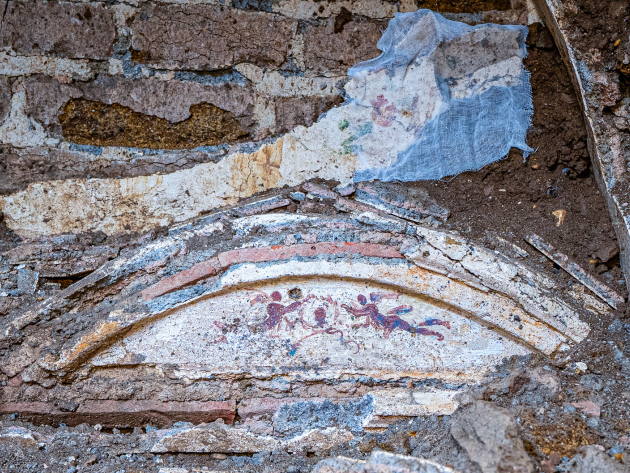
During the preventive archeology investigations conducted by the Ministry of Culture - Special Superintendence of Rome, for the construction of a student residence on via Ostiense, in the St. Paul Outside the Walls area, a vast funerary area was discovered, with decorated masonry tombs and pit burials, exceptionally well preserved.
From the excavation, directed by Diletta Menghinello, archaeologist of the Special Superintendency of Rome, a nucleus of five imperial-era funerary buildings with a quadrangular plan with vaulted roof emerged, at about one meter deep, aligned from north-east to south-west and preceded by two smaller structures. A sixth building, similar to the others but perpendicular to them, suggests, together with the remains of further rooms, the organization of the complex around an internal courtyard.
In the area closest to the road, at gradually greater depths, an apsed hall and another large room with remains of mosaic flooring were also brought to light, both in bricks, whose function will become clear as the investigation proceeds. In late ancient times, a much more modest necropolis was established behind the monumental sector occupied by the tombs of the imperial age, from which it is separated by a long wall made of tuff blocks: in the latter, scant grave goods accompany simple pit burials, superimposed on each other in dense succession.
The particularly rich and stratified context can be traced back to the vast Necropolis of the via Ostiense, which developed between the late Republican age and the late Empire, of which the sectors of the Ostiense Sepulcret and the St. Paul's Cliff are currently visible.
The new discoveries, spread over a long period of time between the early imperial age and late antiquity, constitute a discovery of great importance, capable of providing new and precious information on the topographic layout, as well as on the anthropological, epigraphic and material culture aspects of the Ostiense Necropolis.
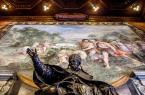
Photo: detail of an arcosolium burial in the Necropolis
 Condividi