
























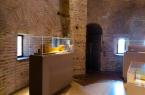



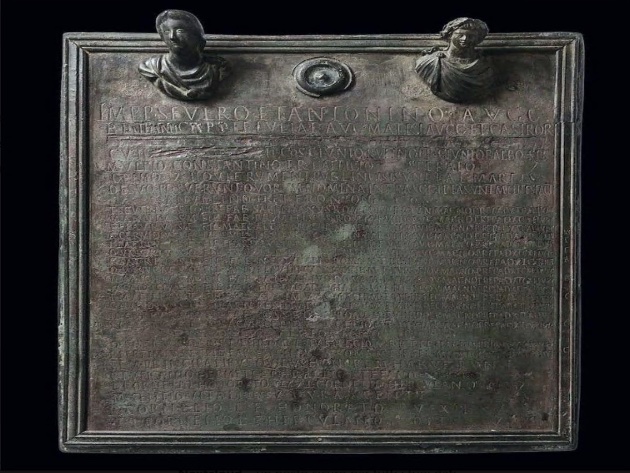
The Hall of the Emperors in the Palazzo Nuovo, within the Capitoline Museums, is hosting a temporary re-display to showcase one of the most extraordinary works in the Capitoline epigraphic collections: the bronze plaque with a dedication from the Vigiles to the Severi.
Thanks to the combination of humanistic knowledge and digital technologies, the artifact, originally decorated with three appliques depicting Septimius Severus, Geta, and Caracalla, is reconstructed for the first time as it appeared during its various phases of life.
The initiative, promoted by Rome's Department of Culture and the Coordination of Initiatives Related to Holocaust Remembrance Day, with the Capitoline Superintendency of Cultural Heritage, is the result of a multidisciplinary collaboration with the University of Verona (Department of Cultures and Civilizations), which led to a 3D survey of the work as part of a broader research project by Professor Dario Calomino, funded by the European Community.
A cutting-edge intervention that led to important scientific confirmation: 3D scans and virtual reconnection with the bust of Septimius Severus held at the British Museum in London have provided definitive proof that the London applique belongs to the Roman slab. The project also offers the opportunity to rediscover the artifact as it originally was, reconstructing its complex historical events from the Imperial Age to modern times.
The new temporary exhibition features the original plate alongside two digitally restored 3D resin prints derived from three-dimensional scanning, which reconstruct two versions corresponding to key moments in its history.
The first reproduction shows the artifact's original state (203 AD) in its configuration prior to the damnatio memoriae of Geta, decorated with busts of Septimius Severus (centre), Caracalla (right), and Geta (left). The portion of the text erased after the public condemnation of Geta's memory has been restored, and his bust generated with Artificial Intelligence.
The second reproduction, hand-painted, is based on the drawing published by scholar Cassiano Dal Pozzo in the Museum Chartaceum in 1650. At this stage, Geta's name was erased and his bust was removed and replaced with that of a Genius, the patron deity of the Centuria mentioned in the dedication, also generated with Artificial Intelligence. Today, the Genius is replaced by a modern female bust.
Both 3D prints also include a reproduction of the bust of Septimius Severus, scanned from the original and digitally added.
The reorganization represents an important opportunity to showcase the Palazzo Nuovo's heritage and the rich collection of 67 portraits in the Hall of the Emperors.
The temporary exhibition of the plate and its 3D reproductions, aligned with the busts of Caracalla and Geta, thus creates a direct and immediate dialogue between the epigraphic documentation and the imperial portraiture of the collection.
Informationen
Dal 4 novembre 2026 al 31 marzo 2027
Tutti i giorni ore 9.30-19.30 (24 e 31 dicembre ore 9.30-14.00; 1° gennaio ore 11.00-20.00: chiuso il 25 dicembre). Ultimo ingresso un’ora prima della chiusura.
 Condividi