










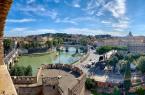


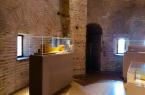



The papal apartments of the Castle of Julius II host the exhibition IN HOC SIGNO. Testimonianze cristiane tra Ostia e Porto (IN HOC SIGNO. Christian Testimonies between Ostia and Porto), dedicated to the establishment and spread of Christianity between Ostia and Porto.
The exhibition presents the most representative testimonies, relating to the material and historical-artistic culture, of early Christianity in the Ostian and Portuense areas, beginning with the coexistence of multiple religions in the 3rd century AD, up to the definitive affirmation of the new faith between the 4th and 5th centuries, and finally arriving at the Early Middle Ages. The works on display, little-known or exhibited to the public for the first time, highlight the great cultural shift that occurred between the 4th and 5th centuries, thanks to the spread of religious symbols that became universal in both public and private spheres. This shift was intertwined with the political and social transformation of the Empire during Late Antiquity, resulting in the emergence of themes and images that have survived to this day.
The two settlements of Ostia and Portus constituted the main port system of antiquity, where different cultures, populations, and religions coexisted for centuries, as evidenced by the numerous discoveries of simulacra of deities such as Mithra, Cybele, Isis and Serapis. Beginning in the 3rd century AD, we witness the progressive diffusion of the Christian faith, evidenced by the production of objects with decorations alluding to the new faith, often reviving and interpreting iconographies already widespread in the classical world. Some artifacts, such as oil lamps, bear the depiction of the criophorus shepherd (ram-bearer), interpreted in Christian terms as the Good Shepherd, along with representations of Orpheus enchanting the animals, alluding to the salvific figure of Christ.
With the end of the persecutions in the 4th century, when Christianity could spread freely throughout the empire, the Emperor Constantine built an imposing basilica in Ostia dedicated to Saints Peter, Paul and John the Baptist, brought to light by recent excavations conducted by the German Archaeological Institute in Rome, while in Portus and on Isola Sacra, two basilicas with presumably different cultic functions stood a short distance from each other. In the city of Ostia, archaeological finds testify to the use of the chrismon - the Christian monogram - on many everyday objects, particularly lamps, rings, and other household items. In the funerary sphere, the spread of the cult is evidenced by glass containers inscribed in gold letters, called refrigeria, used during funeral banquets in honor of the deceased.
Smaller places of worship were also built in Ostia, such as the Oratory of Cyriacus near the Theater and the Oratory of the Baths of Mithras on via della Foce. Fragments of a large marble table decorated with depictions of the Apostles and the Garden of Eden come from this area. For the exhibition, these fragments are returning to Ostia for the first time since their discovery in 1862, thanks to a loan from the Bank of Italy, whose collections they have since merged.
Between the late 4th and early 5th centuries, the cult spread to the suburbs of Ostia with the construction of funerary basilicas such as that of Pianabella, where Christians were buried near the relics of saints. A large circular marble table, used for blessing the food consumed in the ritual banquet in honor of the deceased, a rite practiced until the 5th and 6th centuries, comes from this site. Furthermore, the basilica of Pianabella housed the burials of the inhabitants of Ostia until the 8th century, when the final renovations were carried out: the building was equipped with a new presbyterial enclosure with pillars decorated with painted crosses, a sign of the persistent presence of a community gravitating towards the area.
In Portus, the construction of the basilica in an area once strategically important for its location near Trajan's Basin, transformed into a residential area from the 4th century onwards, documents how the progressive evolution of the city into a port city was accompanied by the affirmation and spread of the Christian faith. Also in Portus, but on the opposite side of the Fossa Traiana (the Fiumicino Canal), in the Isola Sacra district, lies another powerful testimony to the area's Christian identity: the basilica ad corpus, dedicated at the end of the 4th century by Bishop Heraclidas to the Portus martyr Hippolytus, was erected on a series of pre-existing structures on the site where, according to martyrological tradition, Hippolytus was tortured by being thrown into a well. The early medieval phases of the two Portus basilicas are documented by the sumptuous marble decoration that demonstrates the skill of the workshops of the time.
The exhibition ends with a survey of the most recent anthropological investigations conducted in the two districts of Ostia and Portus, which help provide important information on the characteristics of the individuals who populated this area.
All these testimonies reveal the extent and variety of the monumental and historical-artistic manifestations of the early centuries of Christianity: what emerges is a complex and diverse territory, in which Ostia and Portus were the main centers for the spread of the new religion, a role that the two centers maintained and expanded throughout the Middle Ages and the modern era.
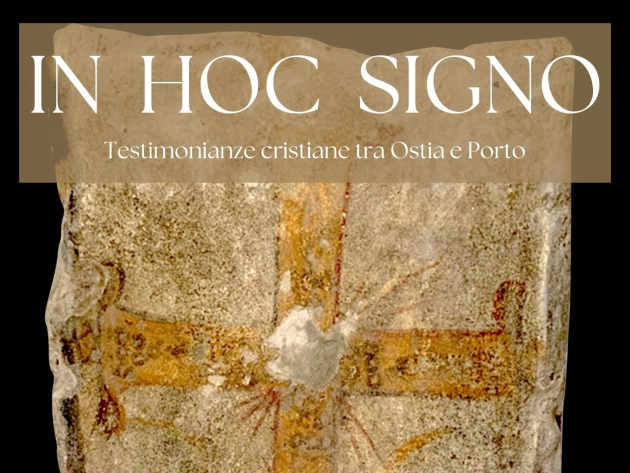
Photo: official poster of the exhibition
Informationen
dal martedì alla domenicaDal 1° novembre al 28 (29) febbraio:Aperto dalle 10:30 alle 16:30Dal 1° marzo al 15 giugno:Aperto dalle 10:30 alle 19:30Dal 16 giugno al 31 ottobre:Aperto dalle 13:30 alle 19:30(Ultimo ingresso consentito, mezz’ora prima della chiusura)Il sito è chiuso il lunedì, il 25 dicembre e il 1 gennaio.
 Condividi