





















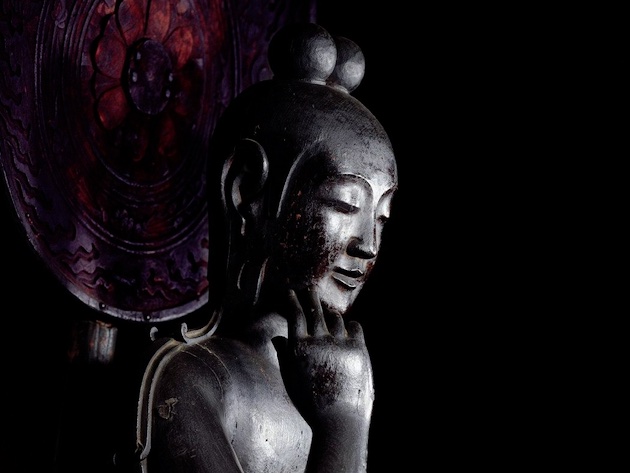
The photography exhibition Statue di Buddha nella terra di Yamato (Buddha Statues in the Land of Yamato) at the Japanese Cultural Institute, curated by Shirai Sayuri and Maria Cristina Gasperini, features 60 photographs by Ogawa Kōzō, through which the Japanese artist explores the iconography of the Buddhist pantheon of the Yamato region, home to the most famous and popular temples in all of Japan. The photographs on display, depicting Buddhas, Bodhisattvas, Celestial Generals, and Kannon, taken between the 7th and 13th centuries, reveal the hidden and secret roots of the Japanese people's soul.
The term "Land of Yamato" was used to refer to the city of Nara until the 19th century. The Nara period (710-794 CE) was a pivotal era in Japanese history, during which the country's first permanent capital, Heijō-kyō (present-day Nara), was established. It was characterized by a strong centralized government modeled after China, a flourishing of Buddhist art and literature, and the construction of imposing temples. The city of Nara housed the Emperor's palace, the center of political and administrative activities, and a large number of temples built by the government. For this reason, the ancient capital is considered the epitome of Buddhist art: numerous artists created some of the greatest masterpieces of Buddhist statuary there.
In the Nara era - 8th century - sculpture underwent three distinct periods, each marked by a distinct style: the years of genesis (beginning of the century), the classical or golden age (towards the middle of the century), and the new era (second half of the century). The first period was marked by the completion of the sculptures of the Hōryūji temple, while the second period was marked by the casting of the gigantic sculpture of the Tōdaiji, the Great Buddha - the largest Buddha statue in Japan (14.98 meters high) - begun in 747 at the behest of Emperor Shōmu (701-756). The final phase corresponds to the arrival from China, in 753, of the monk Ganjin, who founded the Tōshōdaiji temple in 759, introducing new philosophical doctrines and a new statuary style. The interior decoration of this temple marked a turning point in Japanese art, even though it was the last to be executed in dry lacquer, a technique that had fallen into disuse for economic reasons and was now reserved only for works of the highest quality. From then on, wood became the material of choice for depicting images of the Buddhist pantheon.
Ogawa Kōzō (1928 - 2016) was born in Nara, the third son of Ogawa Seiyō, a photographer specializing in Buddhist statues and founder of the Asukaen workshop in the same city. After the war, determined to pursue an artistic career, he studied Japanese and Western painting at the Art Institute of the Osaka City Museum. In 1950, following the enactment of the Cultural Heritage Protection Act, commissioned by the Cultural Heritage Commission (now the Agency for Culture), he devoted himself for five years to photographing Buddhist statuary throughout the country. In 1957, he held his first solo exhibition at the Hankyū Department Store in Osaka. After several attempts to achieve the correct color rendering required for color photography and striking lighting, he arrived at a technique that involved using mirrors to circulate natural light within the room and photograph the sculptures.
Photo: the Japan Cultural Institute Facebook official site
Informations
Maggio - giugno: lunedì -venerdì 9.00-12.30/13.30-17.00
Luglio: lunedì -venerdì 9.00-12.30/13.00-16.30
 Condividi