














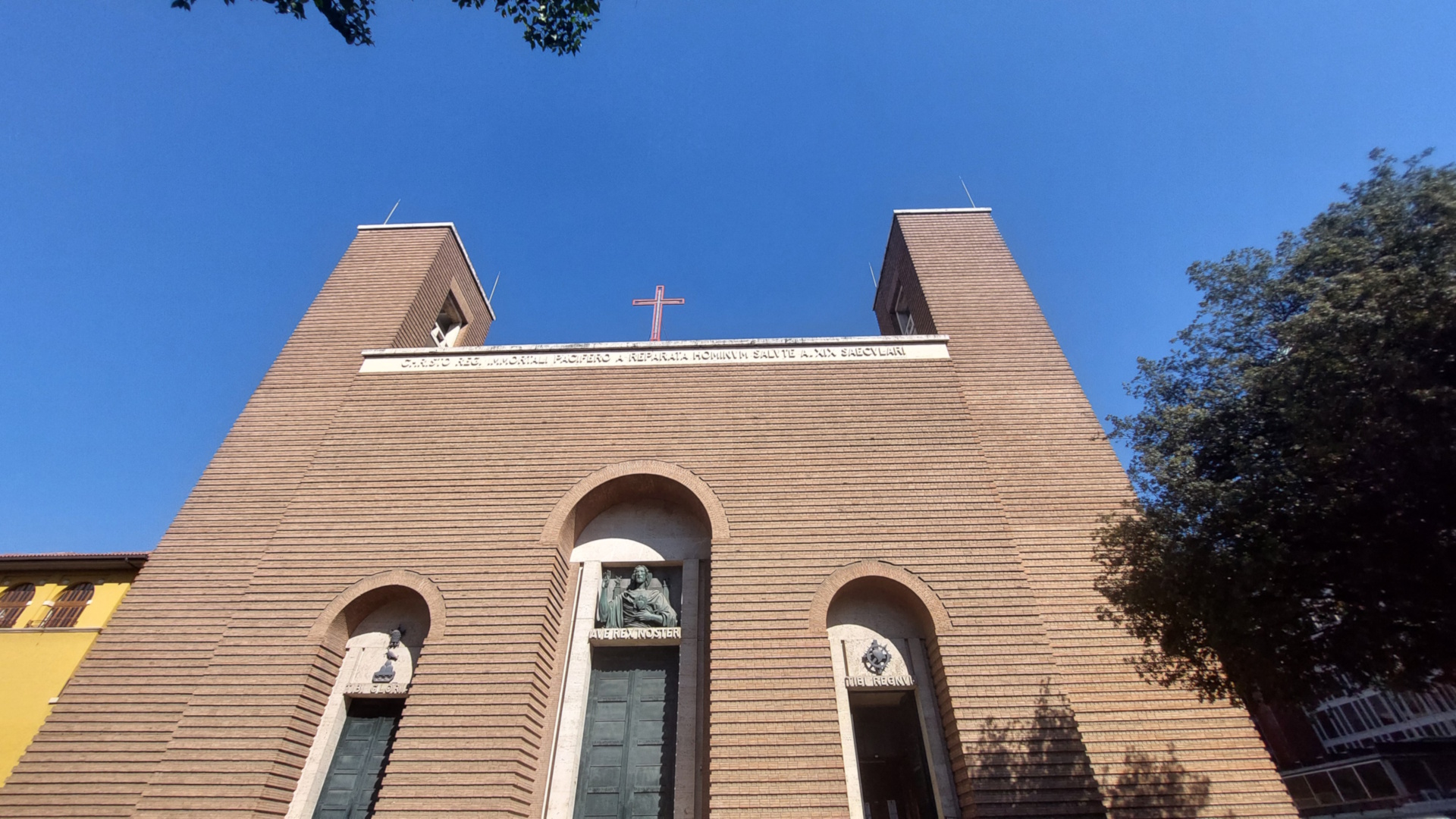
Un mur de briques qui revêt une façade solennelle et austère, précédée d’un escalier en travertin et flanquée de deux clochers jumeaux légèrement en retrait : œuvre de Marcello Piacentini, et souvent considérée comme l’une de ses réalisations les plus emblématiques, l’église située sur le viale Mazzini, dans le quartier della Vittoria, est l’un des premiers exemples du rationalisme italien appliqué aux édifices de culte.
La construction de cette église – dans un quartier alors en pleine expansion et qui avait déjà son centre géométrique dans les jardins de la piazza Mazzini – était due à l'initiative du prêtre français Léon Gustave Dehon, fondateur de la Congrégation des Prêtres du Sacré-Cœur de Jésus, appuyé par le père Ottavio Gasparri, procureur général de l'ordre, homme entreprenant et tenace. Après le carnage de la Première Guerre mondiale, et en mémoire des nombreux morts, l’église devait être un symbole et un augure de paix universelle : son titre complet est, de manière significative, « Temple votif international pour la paix dédié au Sacré-Cœur de Jésus ».
Les travaux (commencés en mai 1920) furent confiés dès le départ à Piacentini, qui conçut initialement un édifice « classique », inspiré des nombreuses églises romaines du XVIe siècle. La mort du père Gasparri en 1929 entraîna toutefois une interruption du chantier : deux ans plus tard, lorsque les travaux finalement reprirent, la production architecturale du régime fasciste avait déjà pris un tournant résolument moderniste. En cours de réalisation, Piacentini modifia alors le projet, qui subit un changement radical, intégrant les exigences de la modernité sans pour autant oublier la tradition architecturale du passé.
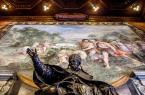
Tout en conservant une approche classique, Piacentini travailla à la simplification et au dépouillement de l’ensemble, afin d’obtenir une structure aux formes claires et linéaires. À l’extérieur, le revêtement en brique est laissé apparent, tandis que les trois portails d’accès (le principal surmonté d’un haut-relief d’Arturo Martini représentant le Sacré-Cœur du Christ-Roi) sont disposés comme les arcades d’un arc triomphal de la Rome impériale. À l’intérieur également, les matériaux de construction sont laissés apparents : le gris des murs est éclairé par la nuance rouge du sol en porphyre, avec quelques autres touches de couleur apportées par le vert des autels et les balustrades dorées des chœurs. Les fresques d'Achille Funi dans l'abside constituent la transgression la plus notable de l'austérité générale : un Christ trônant de près de 12 mètres de haut, qui fit l'objet de sévères critiques à l'époque.
Photo Turismo Roma
Informations
Mass times
Mondays: 07.00, 10.00, 19.00Tuesdays: 07.00, 10.00, 19.00Wednesdays: 07.00, 10.00, 19.00Thursdays: 07.00, 10.00, 19.00Fridays: 07.00, 10.00, 19.00Saturdays and public holidays: 07.00, 10.00, 19.00Sundays and public holidays: 09.00, 10.30, 12.00, 19.00
Times may be subject to change, so please always contact the church
 Condividi
Location
Pour connaître tous les services d'accessibilité, visitez la section Rome accessible.