







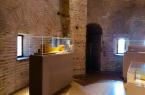
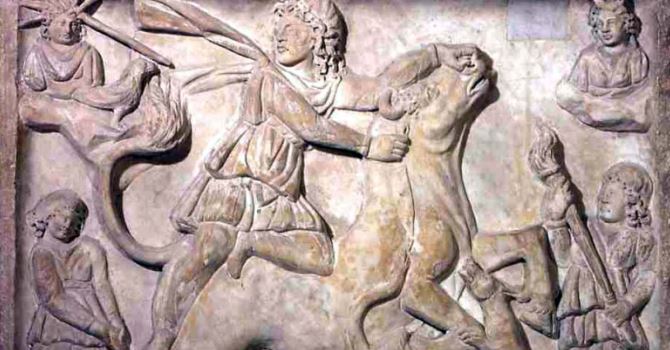
The mithraeum was discovered during the 1930s, when works were carried out to create a storage facility for the sets of the National Opera Theatre at the former Pantanella pasta factory. A large 2nd-century building was identified, in good condition and with refined marble decorations, modified and adapted several times during the 3rd century to make a mithraeum, a place dedicated to the mystery rites of the god Mithras, an Iranian-Babylonian divinity whose cult was mostly widespread in the Roman Empire, especially between the 2nd and 4th centuries AD. The central act of the myth was the sacrifice of the cosmic bull, whose death gave life to the universe.
The current entrance was probably the secondary one, while the main one corresponded with the Circus Maximus. The first room on the right has been identified as an apparitorium, a sort of sacristy, while the second room features a typical element of the Mithraeum: a masonry podium where the initiates sat during the ceremonies and the celebration of the sacred banquet. This bench-like structure can also be found in the last and most important room, the actual sanctuary, the spelaeum, the cave where the encounter with the god took place through various degrees of purification.
Inside an arch, on the back wall, there is a semicircular aedicule that would have contained a small statue of Mithras. The representation of the myth was generally sculpted in a large relief; in this Mithraeum, it was found out of place and placed in the central area of the sanctuary. Above the relief is the donor's dedicatory inscription: “To the invincible sun god Mithras, Tiberius Claudius Hermes offers the image of the god following a vow”.
Information
Admission to the monument is allowed to groups and associations, with their own guide, who must make a reservation at 060608 (daily, 9.00 - 19.00).
Maximum 25 people per visit.
For individual visitors, who must also make a reservation at 060608, individual visits are also possible according to a schedule specified on the page > Monumenti del territorio
 Condividi
Location
To find out about all accessibility services, visit the Rome accessible section.