
























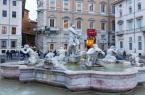







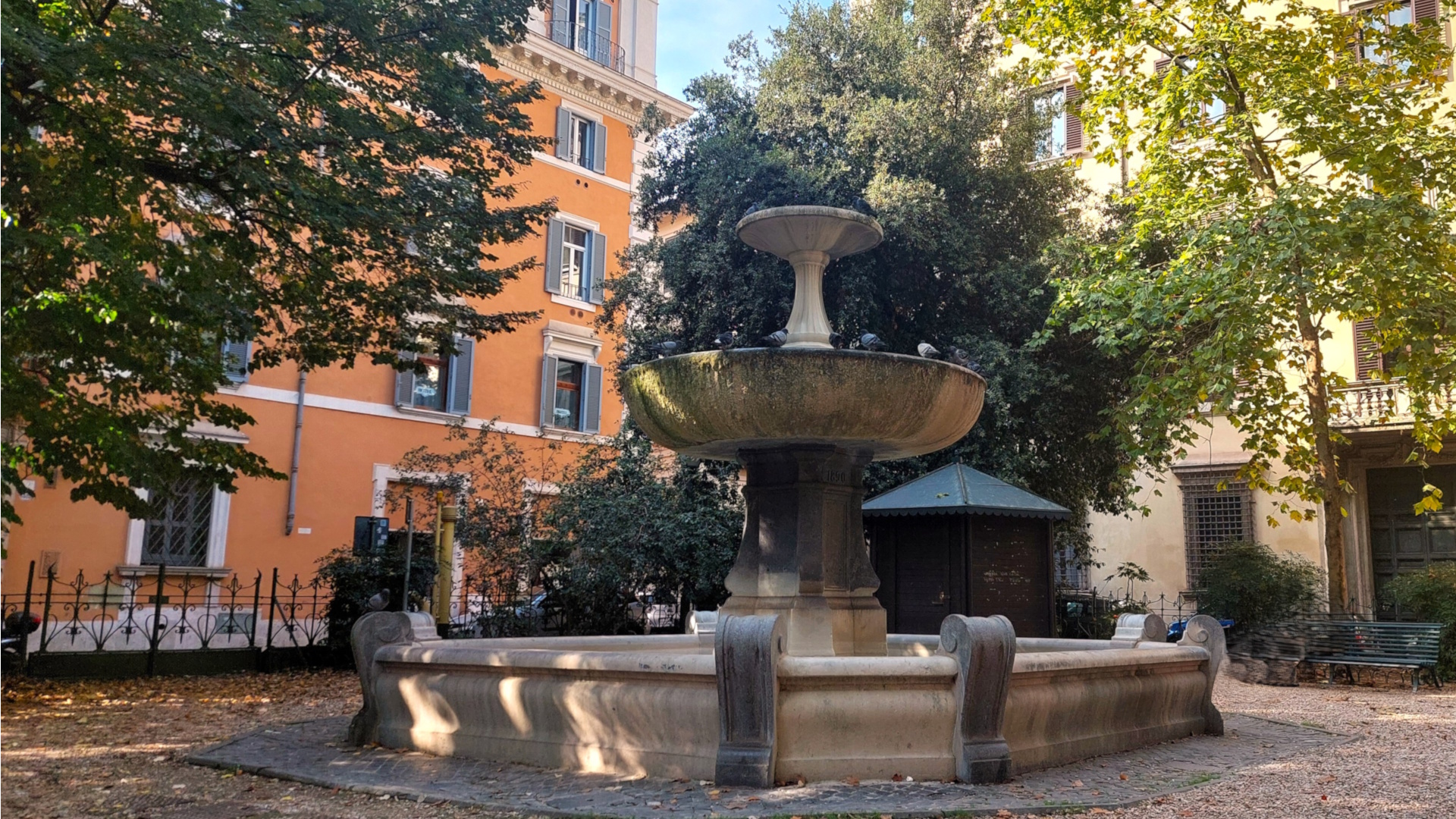
The fountain in Piazza Cairoli, formerly Piazza Branca, stands at the centre of a garden area. It was designed in 1888 by Edouard André (1840–1911), as indicated by an inscription on one corner of the base.
It consists of a quadrangular basin made of Baveno granite, with a pillar at its centre whose decoration (bronze dolphins surrounding a trident) has been lost. The pillar supports a circular basin, found during the 1887 excavations in the nearby Piazza Cenci. Above this is a second pillar supporting a basin from which water flows.
Historical notes
The design of the green area in Piazza Benedetto Cairoli was entrusted to Edouard André (1840–1911), a renowned landscape architect. For the construction of the fountain, the French architect had to follow the provisions of the Municipal Archaeological Commission, which required him to reuse a Roman basin made of a single block of granite from the Forum, discovered in 1887 during excavations for the foundations of a house in Piazza dei Cenci.
André conceived the fountain following a tried-and-tested model: the ancient basin, supported by a square baluster decorated with volutes at the corners, stands at the centre of an octagonal basin in Baveno granite, and is surmounted by another circular basin.
The original decoration of the upper baluster, made of bronze or iron-reinforced bronze and featuring dolphins wrapped around tridents, has been lost; however, the bronze date ‘1890’, commemorating the garden’s inauguration in May of that same year, has been preserved. The architect’s name is engraved on the edge of the octagonal basin, near one of the corners.
The fountain underwent restoration in 1999.
Photo: Fountain in Piazza Cairoli, Sovrintendenza Capitolina ai Beni Culturali Official website
Information
 Condividi
Location
To find out about all accessibility services, visit the Rome accessible section.