

































The Casa dei Grifi (House of the griffins) is one of the oldest Republican domus on the Palatine Hill and is conventionally dated between the late 2nd century BC and the mid-1st century BC; it was discovered during excavations carried out by Giacomo Boni in 1912.
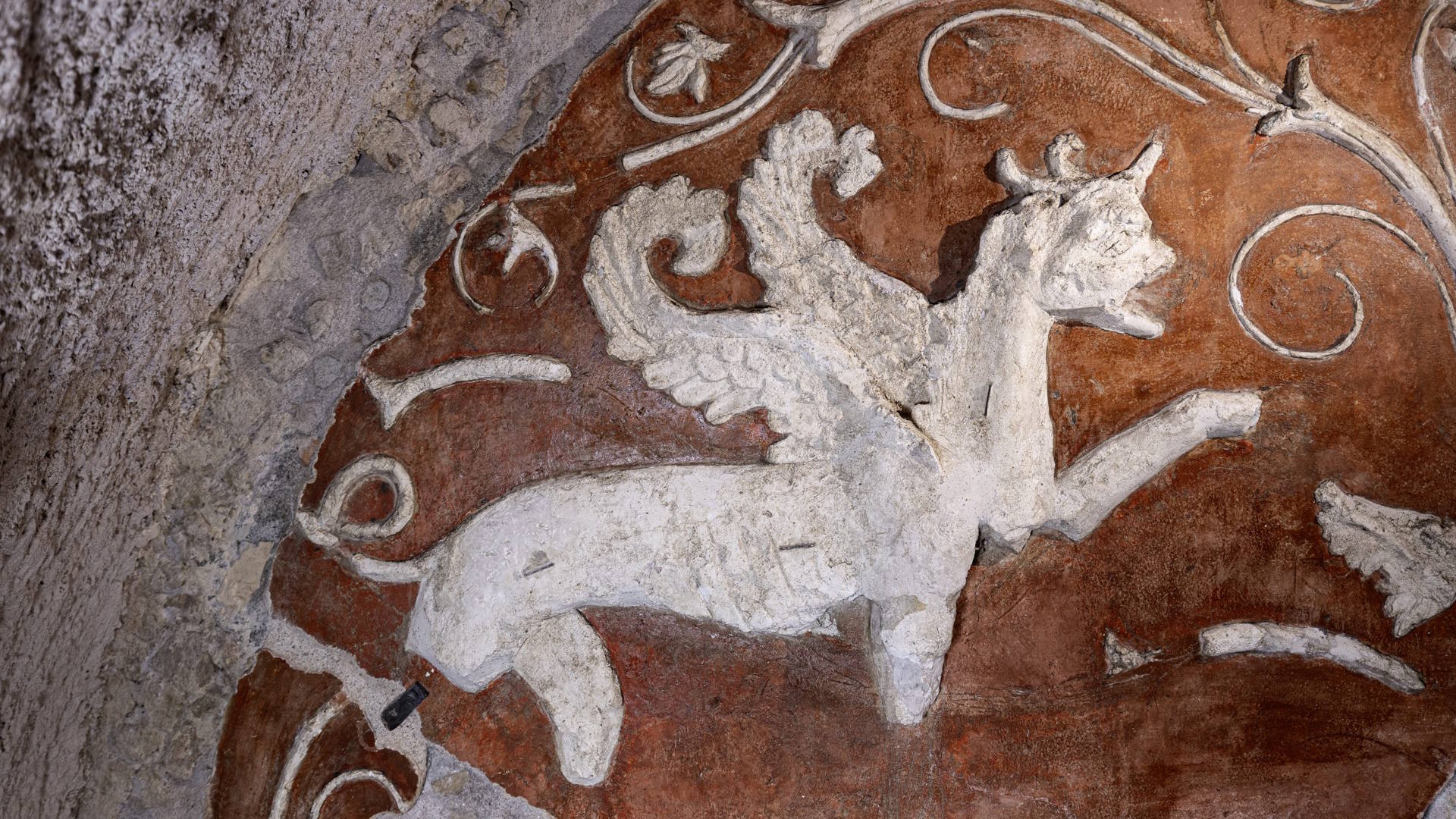
The domus owes its name to two large griffins (mythical creatures with the head of a bird and the body of a feline) in white stucco on red plaster within the lunette of one of the house’s underground rooms: the griffins, depicted in a heraldic pose and in profile, are positioned in front of a lush acanthus bush. The house, spread over several levels that take advantage of the hill’s slope, is in an excellent state of preservation, as it was almost completely obliterated (and thus preserved) from the early years of the Imperial age until the last great monumentalisation of the hill with the construction of the Flavian imperial palace (namely the Domus Augustana and the Domus Flavia). The massive foundations of the palace complex cut through the two levels of the domus, disrupting the original layout but effectively preventing further deterioration until the site’s discovery.
Today, in fact, the Republican-era rooms, although they have lost their original layout, preserve the evocative history of at least three centuries of use, refunctionalisation and abandonment. The lower, underground level of the domus is accessible only through a steep staircase. Eight rooms with walls decorated with paintings, combined with stucco work and mosaic floors of white tiles with black frames decorated with polychrome tiles or inlays, are preserved. The paintings, especially, are considered among the best-preserved examples of illusionistic representations of architectural elements such as columns and pilasters, originally created with stucco but now skilfully painted.
The most emblematic example is in the decoration of the large central room. The walls depict a colonnade on a projecting podium that faces a series of orthostats and panels of inlays and various marbles. Together, these elements recreate the illusion of an elegant interior. Like all the other rooms, the central one is decorated with exquisite mosaic floors. It is further enriched by a black-and-white tessellated floor, which features a central pseudo-emblem framed in antique red and decorated with perspective cubes. These cubes are created by combining white (palombino), green (marly limestone from northern Lazio), and black (slate) stone materials.
Photo: Parco archeologico del Colosseo, House of the Gryphons, Detail of the stucco lunette featuring a gryphon, Photo: Simona Murrone
Information
Dal 3 marzo 2026
Giorno di apertura: Martedì
Percorso didattico accompagnato in italiano alle ore 14.00 e in inglese alle ore 15.00
Durata 30 minuti
 Condividi
Location
To find out about all accessibility services, visit the Rome accessible section.