




















Location
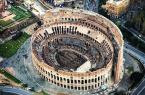
Just a stone’s throw from iconic landmarks such as the Colosseum and the Circus Maximus, nestled between the Palatine and Caelian Hills, there still exists a Rome unknown to most – a parallel city that lies off the beaten track, characterised by tranquillity, unusual views and millennia-old memories, where the chaos and hustle and bustle of the fast-paced city give way to an intimate atmosphere, as if suspended in time.
It is the Rome that lies at the heart of the Caelian Hill, one of the city's seven hills, on which stand, amongst other things, the Basilica of Saints John and Paul, the Roman Houses and the Church of St Gregory. Against this extraordinary backdrop winds one of the Rome's oldest and best-preserved streets: the Clivus Scauri, a route that transforms a simple stroll into a journey through the history of the Eternal City.
Very few streets in Rome can boast, like the Clivus Scauri, such exceptional continuity in both their route and their name. Walking along it means following one of the routes that has remained most faithful to ancient Rome. Moreover, the Clivus still retains its original Latin name, Clivus Scauri, documented both by a Roman inscription and by medieval sources from the eighth century onwards.
The origin of the street is generally attributed to a prominent member of the powerful gens Aemilia, most probably Marcus Aemilius Scaurus, consul in 115 BC, censor in 109 BC, and one of the most influential figures of the late Roman Republic.
The Clivus Scauri climbs the ancient slope that connected the area between the Colosseum and the Circus Maximus with Piazza dei Santi Giovanni e Paolo, at the summit of the Caelian Hill. Even in antiquity, this hill was one of the most prestigious areas of Rome and, particularly during the 4th century AD, was home to magnificent domus surrounded by extensive gardens, residences belonging to the wealthiest and most influential families of Imperial Rome.
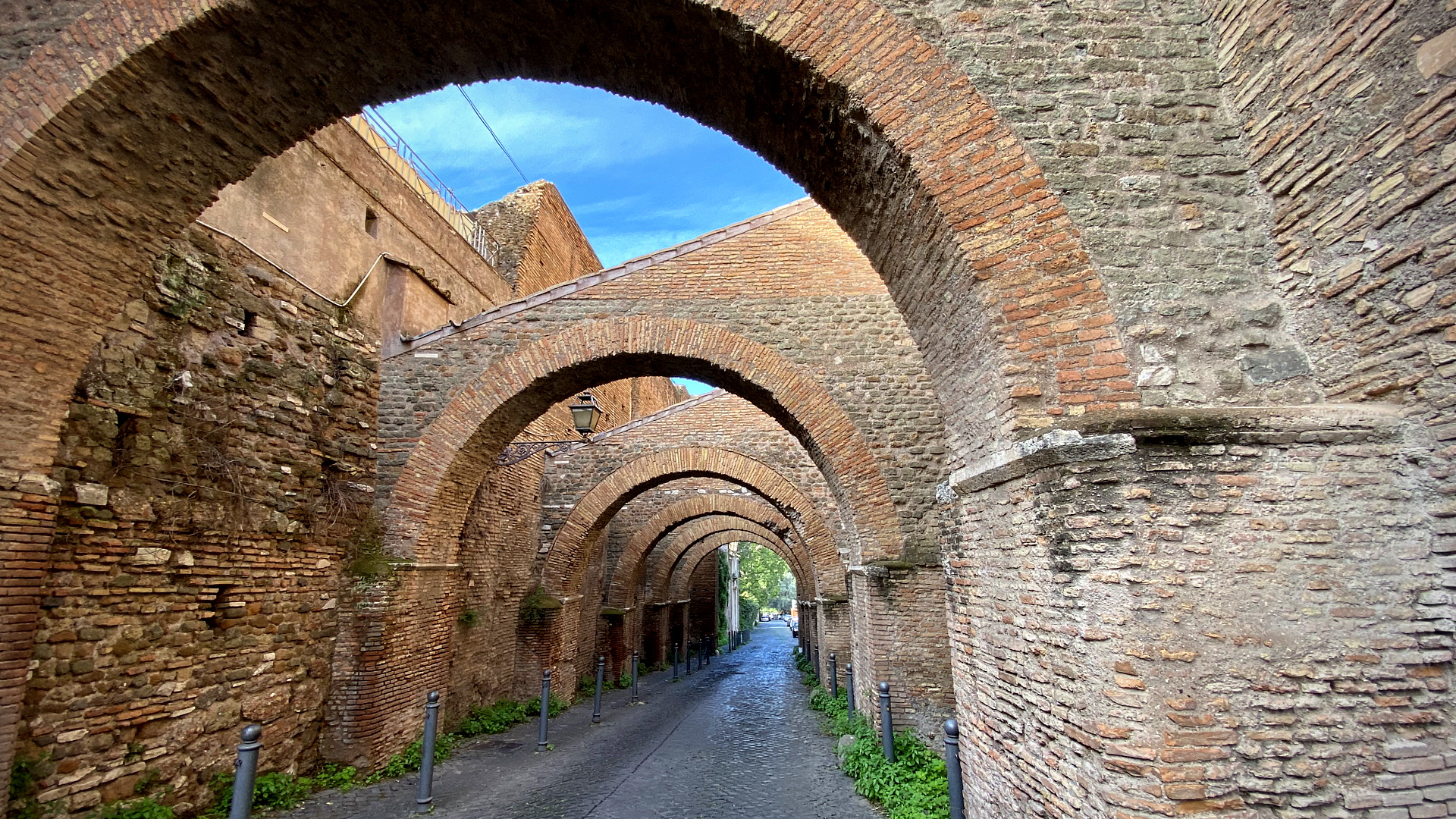
What makes the Clivus immediately recognisable are its striking brick arches, which make it one of the most photographable views in the city. Of these evocative passages, only one belongs to the Late Antique period; almost all the others are medieval reconstructions that replaced structures already existing in Roman times. Until the 16th century, they were even surmounted by a second tier of arches, making the route even more monumental and captivating. The first arches are in fact the imposing buttresses built to support the Basilica of Saints John and Paul after the severe damage caused by the barbarian invasions of the 5th century.
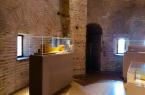
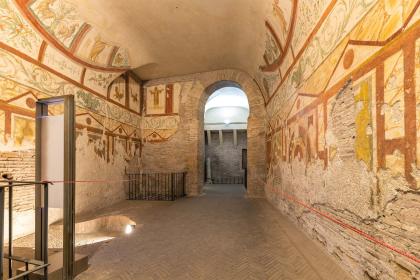
Alongside the basilica lies one of Rome's most fascinating archaeological complexes: the Roman Houses of the Caelian Hill. Discovered in 1887 by Father Germano of San Stanislao, then rector of the basilica, they represent an exceptional example of urban stratification. Frescoed rooms, decorated halls and structures belonging to different periods reveal the transformation of ancient aristocratic houses into places of Christian worship.
According to tradition, this was the home of Saints John and Paul, officials of the Imperial court who, during the reign of Emperor Julian the Apostate (AD 361–363), were martyred and buried in their own house, above which, in the following centuries, the basilica that still dominates the hill today was built.
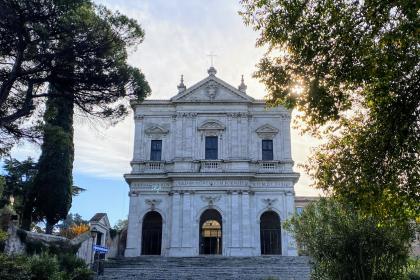
Descending towards the Church of St Gregory, you can encounter further precious fragments of history. This was the site of the family home of Pope Gregory the Great, who, in the 6th century, transformed the family property into a monastery and an important centre of assistance. Parts of the complex still survive, including an elegant 17th-century gateway and the remains of what has been identified as the monastery's ancient library, originally founded in an earlier period by Pope Agapetus.
The Clivus Scauri is much more than an ancient Roman street: it is a place to be experienced without haste, where you can lose yourself among fragments of history, ancient buildings and the silence of another age. Here, Rome tells its story through its stones and through that unique atmosphere which still allows you to sense the splendour of its glorious past.
Clivus Scauri Ph. Turismo Roma
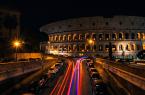
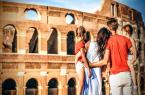
The Flavian Amphitheatre (The Colosseum)

 Condividi
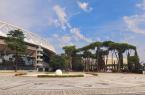
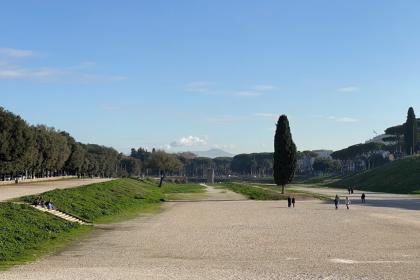
Circus Maximus
 Condividi
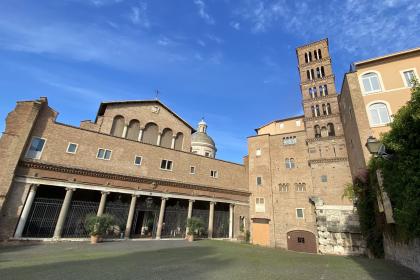
Basilica of Santi Giovanni e Paolo al Celio
 Condividi
Celio Roman Houses
 Condividi
Church of San Gregorio al Celio and Oratories of Sant'Andrea, Santa Silvia and Santa Barbara
 Condividi