

































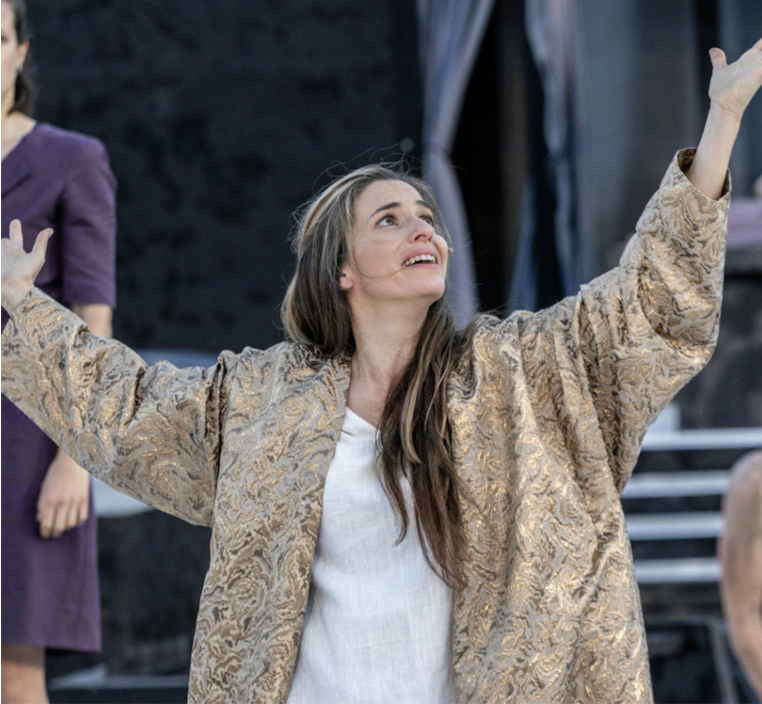
Euripides' Alcestis arrives on stage at the Roman Theatre of Ostia Antica, directed by Filippo Dini, as an ancient tragedy that seems to have spanned the centuries to speak to us of the present time.
Performed in Athens in 438 BC, it is the oldest of Euripides' tragedies that have survived. Written as the conclusion of a tetralogy that included The Cretans, Alcmaeon and Psophis, and Telephus, it is inspired by a myth also recounted in Plato's Symposium. The play tells the myth of Alcestis and of Admetus, king of Thessaly, who obtained from Apollo the right to escape Thanatos on the condition that someone else sacrifice themselves by dying in his place; none of his closest relatives however, was willing to do it, except his young wife, Alcestis. The tragedy ends with the benevolent intervention of Heracles, who rescues the woman from the underworld and brings her back to the world of the living.
A unique work of its kind, it has been defined by scholars as a tragicomedy because it is the only one to have a happy ending, and also because Alcestis's choice to meet her tragic fate is counterbalanced by the figure of a drunken Heracles, the protagonist of some of its scenes of pranks and revelry, typical of satyr drama.
In Dini's interpretation, Euripides' tragedy is not simply the story of a woman who chooses to die in place of her husband Admetus. Over this perfect theatrical machine looms the shadow of Ananke, the deity who personifies the system of thought of ancient tragedy: the knot of fate that no one can untie, not even the gods, and which binds everyone to everything. Thus, at the heart of the tragedy is the figure of this exceptional woman who sacrifices herself for the love of her husband and returns from the dead. But the woman who returns from the afterlife is no longer the same, having seen and experienced horror and despair. She who is reunited with her husband is a sacred and mysterious being unparalleled in literature and art. Euripides' tragedy, therefore, in this contemporary reading, reconnects with the journey of women throughout history, from the beginning of time to the present, with their evolution, their tragic daily deaths, and their ability to return from the horror to face the object of their love.
With Alessio Del Mastro (Apollo), Luigi Bignone (Thanatos), Sandra Toffolatti (Maid), Deniz Ozdogan (Alcestis), Aldo Ottobrino (Admetus), Denis Fasolo (Heracles), Filippo Dini (Ferete), Bruno Ricci (Servant); Choir leader: Carlo Orlando; Choir: Simonetta Cartia, Gennaro Di Biase, Riccardo Gamba, Lucia Limonta, Margherita Mannino, Carolina Rapillo, Ottavia Sanfilippo, Roberto Serpi, Chiarastella Sorrentino, Dalila Toscanelli.
Photo: official poster of Teatro di Roma
Informations
Venerdì e sabato ore 21.00
 Condividi