




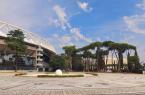

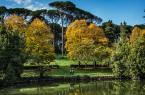






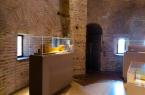



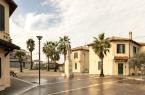

A peaceful plot of land tucked behind St. Peter’s Basilica, sheltered by a high boundary wall and with palm trees and cypresses amongst its gravestones. A pilgrimage destination for people from Northern Europe as far back as the early Middle Ages and an essential stop in Rome on the Grand Tour, the Campo Santo Teutonico is considered the sole cemetery of the world’s smallest nation. In reality, it is situated on Italian territory, in an area which is nonetheless subject to extraterritoriality in favour of the Holy See, just like the adjacent, modern Paul VI Hall.
The oldest Germanic institution in Rome – within whose walls Catholic pilgrims and residents of the city, both German- and Flemish-speaking, have found rest for centuries – occupies part of the site of the Circus of Caligula and Nero, which, according to Christian tradition, was the scene of the city’s first martyrs, including the apostle Peter. The origins of the complex are generally traced back to the late 8th century, when Charlemagne is said to have obtained the land from Pope Leo III for his “Schola Francorum”: a charitable institution for the many pilgrims arriving from the regions north of the Alps, comprising a church, a hospice, a hospital and a cemetery.
By the fifteenth century, however, the cemetery and its adjoining buildings were in a terrible state. The funds for the urgent restoration work were provided by German and Flemish members of the Roman Curia (at the initiative of Friedrich Frid, a German originally from Magdeburg), who oversaw its reconstruction and upkeep, founding a confraternity in 1454 and giving the site its present form. At the end of the sixteenth century, Pope Gregory XIII elevated the confraternity to the rank of the “Arciconfraternita di Santa Maria della Pietà nel Campo Santo”, which remains the cemetery’s principal custodian to this day, alongside the Pontifical Teutonic College.
In accordance with the 17th-century layout, the cemetery is divided into four raised areas or “campi”: a medieval popular tradition holds that its soil consist of sacred earth from Calvary. The inner wall features the Stations of the Cross commissioned in 1757 by the Archconfraternity, whilst some of its sculptures come from the Church of Santa Elisabetta dei Teutonici, which was demolished in the late 19th century to make way for Corso Vittorio Emanuele II. A surprising number of distinguished figures from the German-speaking world – though Romans by adoption – are laid to rest within the cemetery’s approximately two square kilometres: among others, the painter Joseph Anton Koch, the sculptor Heinrich Maximilian Imhof, the collector and archaeologist Sibylle Mertens-Schaaffhausen, and the noblewoman Carolina von Sayn-Wittgenstein, who was Franz Liszt’s long-time lover.
From the cemetery, access is gained to the 15th-century church of Santa Maria della Pietà: in one of its chapels, frescoed by Polidoro Caldara da Caravaggio (a pupil of Raphael), lie the Swiss Guards who fell during the Sack of Rome in 1527.
Information
 Condividi
Location
To find out about all accessibility services, visit the Rome accessible section.