







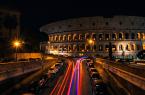






















Greater safety, enhanced public transport, better-lit streets, improved urban maintenance and a network of community support points to help people enjoy the city after dark. These are the aims of the Rome Night Plan (Piano Roma Notte), the new integrated programme promoted by Roma Capitale. Launched in July, the initiative focuses in particular on Thursday, Friday and Saturday evenings, when the city experiences its highest levels of nightlife, tourism, events and commercial activity.
One of the programme's most significant measures concerns public lighting, with the upgrading of 3,000 street lamps using new LED technology, increasing brightness by 30% in squares, nightlife districts such as Trastevere and San Lorenzo, parks, car parks and major public transport hubs, including Termini, Trastevere and San Lorenzo stations. The programme covers 745 streets and more than 10,000 lighting points, including the installation of 210 new illuminated pedestrian crossings, particularly in suburban areas, as well as the gradual upgrading of self-illuminated ATAC bus shelters. Residents can also report lighting issues through the Illumina app.
The plan also places strong emphasis on night-time mobility, making travel safer while reducing the need to use private cars or walk long distances after an evening out. From Saturday evenings, the frequency of the nMA, nMB, nMB1 and nMC night bus services, which follow the Metro routes, will be doubled. From Thursday to Saturday, stewards will also be present on board vehicles and at the most sensitive stops.
Among the main innovations is "Come Back Home", a new service comprising six circular night bus routes operated by 12-metre buses, with dedicated routes and request stops connecting the city's main nightlife and cultural districts. The plan also includes app-based van pooling services, shuttle buses with waiting times of less than ten minutes, and a €1 million mobility bonus to support the use of on-demand taxis by women, people under 26, over 70 and vulnerable individuals.
Another key element of the project focuses on urban maintenance, considered essential for improving both quality of life and the perception of safety. Cleaning and maintenance operations have therefore been intensified in the city's busiest areas, while the installation of 114 glass recycling machines with reward incentives is continuing.
The plan also invests in technological innovation through the new Smart Police Support (SPS) video surveillance system, capable of managing up to 15,000 cameras. The platform will integrate 3,000 new CCTV cameras, the approximately 2,500 cameras already owned by Roma Capitale, and those operated by municipal companies, creating a single monitoring system to support the Local Police and Civil Protection. The expansion of free public Wi-Fi is also continuing across connected public squares and Metro stations. The service is already available along the entire Metro Line A, almost all of Line B, and will soon extend to Line C.
To strengthen security on the ground, the night-time presence of the Local Police will be doubled through the deployment of 20 additional patrols across the city's municipalities. For the first time, "Night Tutors" will also be introduced, with up to 150 operators in the initial phase. Working in teams made up of Civil Protection staff, the Social Operations Centre and Third Sector volunteers, they will be easily identifiable by their bibs and ID badges. They will operate in the main nightlife areas, promoting responsible behaviour, providing mediation and first-line assistance, and reporting crimes, incidents of violence and situations of urban decay to the authorities.
The "Rete Roma Notte" (Rome Night Network) Protocol, valid for two years and renewable, establishes a permanent partnership between Roma Capitale, the Prefecture, the Police Headquarters, the Carabinieri, the Guardia di Finanza, Civil Protection, Third Sector organisations, associations, businesses and tourism operators. As part of the initiative, the "Rete dei Porti Sicuri" (Safe Havens Network) will also be created, enabling shops, entertainment venues, restaurants and accommodation providers to serve as welcoming and safe reference points for residents and visitors, helping to strengthen safety in the city's busiest areas.
The entire system is supported by an organisational model coordinated by the Sala Sistema Roma operations centre and by dedicated communication tools, including the 060606 and 800854854 helplines, the Julia app and a WhatsApp channel, through which residents and visitors can obtain information and access the network's services.
 Condividi