















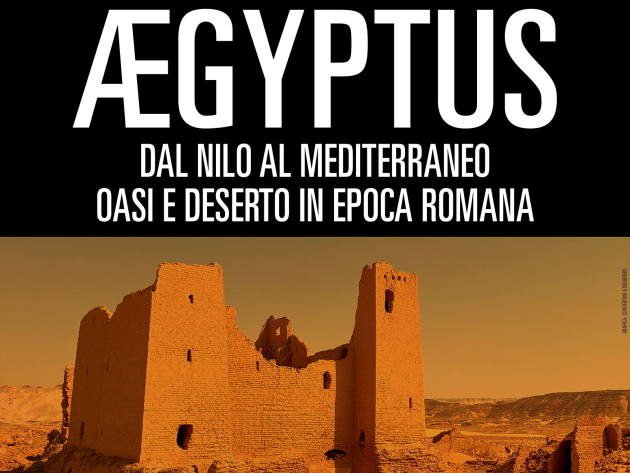
The exhibition project AEGYPTUS – Dal Nilo al Mediterraneo. Oasi e deserti in epoca romana (AEGYPTUS – From the Nile to the Mediterranean. Oases and Deserts in Roman Times) at the National Roman Museum – Museum of Saved Art, conceived by Elisabetta Bruscolini and curated by Alfonsina Russo, Elisabetta Bruscolini, Angelo Piero Cappello, Federica Rinaldi, and Alessio De Cristofaro as part of cultural cooperation activities with Africa and the Mediterranean, recounts a little-known chapter in ancient history: the Roman presence in the oases of the Western Desert of Egypt between the 1st century BC and the 5th century AD.
Promoted by the Ministry of Culture, the exhibition uses video art, archaeology, and artificial intelligence to narrate the Roman desert. It is part of the Ministry's strategic guidelines, aimed at combining scientific research, technological innovation, and the valorization of cultural heritage. It draws on the essential contribution of archaeologists engaged in Greco-Roman excavations in Egypt, carried out with the support of the Egyptian Ministry of Antiquities. AEGYPTUS is a large immersive, cross-media installation that transforms the visit into a sensorial and narrative experience in which video art, digital reconstructions, images of archaeological excavations, animations, and artificial intelligence guide the public through the oasis landscape and the Roman desert, making the narrative of contemporary archaeological research accessible and engaging.
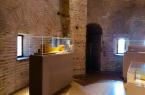
The exhibition, featuring significant archaeological finds from the collections of the National Roman Museum, which oversaw their identification and selection, presents the recovery and investigation activities conducted by the Carabinieri Command for the Protection of Cultural Heritage, the protagonist of the Museum of Saved Art, housed in the Octagonal Hall. The juxtaposition of the finds with the audiovisual and digital content generates an interesting interplay between history and innovation, offering a new interpretation of Roman Egypt.
At the centre of the narrative are the oases, symbolic places of encounter and exchange between cultures, trade, religions, and different peoples, in a strategic territory that for centuries served as a bridge between Africa, the Mediterranean, and the Near East. In this sense, the desert appears not as the periphery of the Empire, but as a vital space of connection, exchange, and cultural contamination, where diverse experiences, identities, and civilizations intertwine.
The exhibition is accompanied by a Public Program of meetings and discussions with Italian and international archaeologists and scholars, designed to engage the public in the research, protection, and valorization of cultural heritage. The events will take place during the first week of the exhibition, from 9:00 PM to 11:00 PM, in the space in front of the exhibition venue. The project is accompanied by a scientific catalog, edited by the Department of Literary, Philosophical, and Art History Studies at the University of Rome Tor Vergata. The initiative involves scholars and archaeologists from leading Italian and international universities and institutions, including the University of Rome Tor Vergata, the University of Milan, the Polytechnic University of Milan, the University of Salento, the Federico II University of Naples, the University of Padua, and the University of Leicester.
Photo: official poster of the event
Informations
 Condividi