





















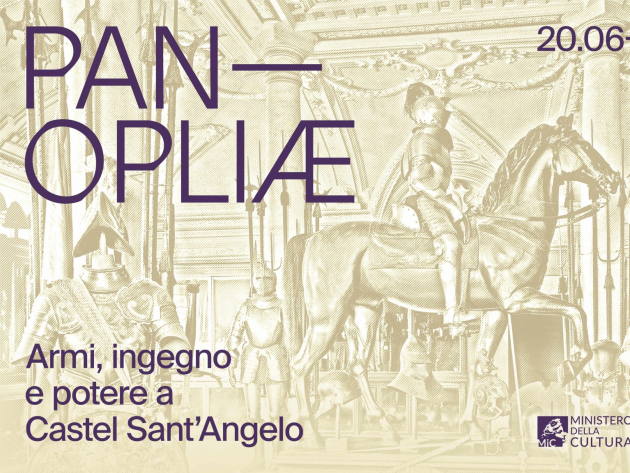
The exhibition Panopliæ. Armi, ingegno e potere (Panopliæ. Weapons, Ingenuity, and Power) - curated by Luca Mercuri, director of the institute, and Mario Scalini, a scholar of ancient weapons and a former director of the Ministry of Culture - presented in the halls of the National Museum of Castel Sant'Angelo, stems from the desire to bring to light an important collection long preserved in the museum's storage rooms. After a lengthy campaign of reconnaissance, study, and restoration, a first selection of Castel Sant'Angelo's historic weapons is now once again accessible to the public.
For the exhibition, the weapons return to the spaces that were originally set up as the Armory of the National Museum of Castel Sant'Angelo, thus restoring these spaces to a function closely tied to the history of the Castle and its collections. Built as a mausoleum for Emperor Hadrian and transformed over the centuries into a fortress, papal residence, state prison, and military garrison, before becoming the National Museum in 1925, Castel Sant'Angelo is the ideal place to house these collections, which were formed over the course of the twentieth century through acquisitions, donations, and transfers from other institutions. Among the most significant contributions are the collection of Umberto Zanvettori, acquired in 1927, pieces from the connoisseur Remo Fedi in the 1930s and 1940s, and numerous artifacts from Palazzo Venezia, the Bargello, the Museo Artistico Industriale in Rome, and Capodimonte.
The exhibition, which unfolds across six rooms, spans over a millennium of history, divided by themes and eras: the heroic world of the Middle Ages, the great patrons of the Renaissance, the courts and navies of the seventeenth century, and the revolution in firearms. Among the pieces visitors can admire along the way are, among others, Corinthian helmets from the sixth and fifth centuries BC, which are among the oldest exhibits; the helmet with a fan visor that may have belonged to Roberto Sanseverino, a condottiero serving the Republic of Venice who fell at Calliano in 1487, displayed alongside a reproduction of his tombstone preserved in the Trento Cathedral; a rare German Hakenbüchse from the early sixteenth century, one of the first firearms destined to transform warfare; the armours linked to the great Italian dynasties, including the barrier corselet of Cardinal Odoardo Farnese attributed to the famous armorer Pompeo della Cesa and the morion of Pierluigi Farnese's personal guard. In the section dedicated to the Medici tradition, thanks to a loan from the Bargello National Museum in Florence, we recall the reunion of a breastplate with the Maltese cross with two precious gauntlets from the Castel Sant’Angelo collection, recognized and restored as part of the same armor made for the young Giovan Carlo de’ Medici (1611–1663), presented in dialogue with his portrait from the collections of the Uffizi Galleries.
There are also weapons used by the papal militias, up to the revolver box donated in 1864 to Giuseppe Garibaldi by the English writer Caroline Giffard Phillipson, a testimony to the great admiration that the figure of Garibaldi aroused in the Anglo-Saxon world.
The restoration work - led by Merj Nesi for the occasion and, previously, by Antonio Mignemi, Nicola Salvioli, and Mari Yanagashita - recovered valuable collections, whose provenance was reconstructed, restoring great and significant importance to the collections of Castel Sant'Angelo.
Photo: official poster of the exhibition
Informaciones
Dal martedì alla domenica, dalle ore 9.00 alle ore 19.30 (ultimo ingresso ore 18.30)Chiuso il lunedì.
 Condividi