

















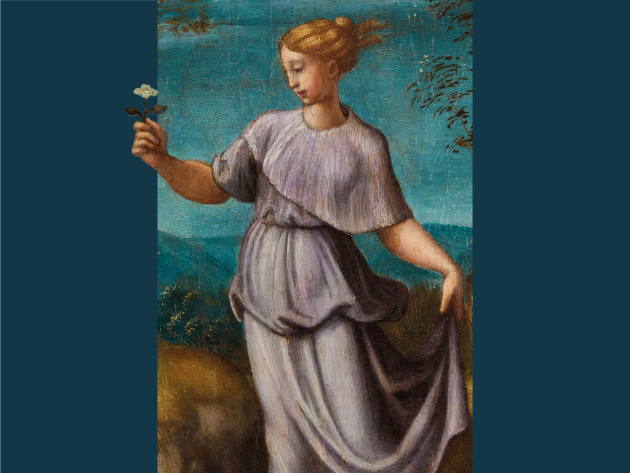
From March 17 to May 10, 2026, the Borghese Gallery hosts the exhibition Ritorno alla Galleria Borghese. Giovan Francesco Penni e la bottega di Raffaello (Return to Galleria Borghese. Giovan Francesco Penni and Raphael's Workshop), curated by Lucia Calzona, which celebrates the return to the Gallery of the Allegory of Good Hope, attributed to Giovan Francesco Penni and acquired at auction in May 2025. The purchase is part of the museum's strongly supported project to reconstruct and restore to the public the original appearance of its collection, through a careful and rigorous reconstruction of the museum's historical and collecting identity.
The arched panel, whose provenance from the Borghese Gallery is attested in 17th-century inventories as a work by Raphael, with whom Penni was a close collaborator, is displayed in the very room that houses Renaissance painting and masterpieces by the great Umbrian and Tuscan master, marking a reunification long-awaited for over two centuries. The Allegory of Good Hope is presented alongside Charity, its original pendant, which is now in a private collection. The recomposition of the diptych, separated at the end of the 18th century, offers the opportunity to retrace the history of the collection, from its first mentions in inventories to the Ottley Sales (1797–1799), which dispersed numerous works under the pressure of Napoleonic events.
Alongside the two panels, the exhibition explores the figure of Giovan Francesco Penni (1488-1528), a key figure in the diffusion of Raphaelesque art in early 16th-century Rome. The presence of the Adoration of the Child with Saint Joseph and the Infant Saint John, for example, from the Abbey of the Holy Trinity in Cava de' Tirreni, one of the artist's few confirmed works, provides a fundamental point of comparison for the attributional study of the Borghese panels.
The integration of the three works with the masterpieces in the room provides a comprehensive picture of the master's workshop, highlighting the stylistic continuities and collaborations that characterized the group's output. The exhibition thus intertwines the history of collecting, the search for attributions, and a reflection on the shared workshop work, revealing the complexity of early 16th-century figurative culture.
Photo: official poster of the exhibition
Informaciones
dal martedì alla domenica dalle 9.00 alle 19.00
Ultimo ingresso alle ore 17.45
 Condividi