









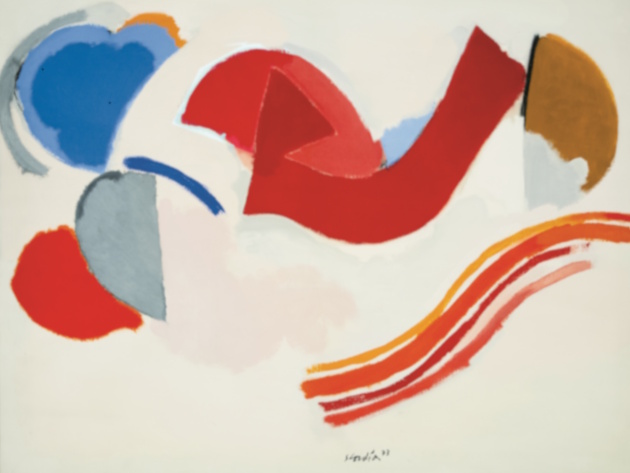
The Casino dei Principi - Musei di Villa Torlonia is hosting an anthological exhibition dedicated to the painter Antonio Scordia, born in Santa Fe to Italian parents in 1918 but raised in Rome, the city where he chose to work despite opportunities in Argentina and residencies in Paris, New York and London. Close to the Roman School in his youth and later a leading figure in Italian abstract art, Antonio Scordia is an artist well known to historians and art critics but little known to the public, with the last exhibition of his works in public spaces in Rome dating back to the late 1970s.
The exhibition is curated by Giovanna Caterina de Feo, promoted by Roma Capitale, Department of Culture, Capitoline Superintendence of Cultural Heritage, and produced and supported by Galleria Mucciaccia in collaboration with the Antonio Scordia Archive. It offers a comprehensive overview of the artist’s work, with paintings from the National Gallery of Modern and Contemporary Art, works from private collections or owned by Scordia’s heirs, and a selection of archival documents.
Early works include, for example, “La seggiola e il gatto” - The Chair and the Cat, acquired in 1952 by Palma Bucarelli for the National Gallery of Modern and Contemporary Art and still attributable to the figurative style of the Roman School. The canvases from the second half of the 1950s (from “Ruderi nel parco” - Ruins in the Park to “Figura bianca” - White Figure) are already focused on the path that would lead the artist towards abstraction and the development of a poetic, colourful and enchanted style of painting. After the large canvases of the 1960s, including “Gorgone”, the exhibition culminates in a rich selection of lyrical and mature works from the 1970s and 1980s, such as “Specchio Blu” - Blue Mirror from 1978 and “Pietra Lavica” - Lava Stone from 1986, which reveal Scordia’s creative verve.
The exhibition concludes with an in-depth look at the artist’s little-known work in the field of decorative arts. Visitors can admire some ceramics from the 1940s and, above all, the tapestry based on his cartoon for the Turbonave Raffaello in 1962, a precursor to the monumental tapestry created a few years later for the Ministry of Foreign Affairs, now preserved in the Sala dei Trattati Europei “David Sassoli” at the Farnesina. The entire exhibition is accompanied by unpublished drawings from the Antonio Scordia Archive.
Header: Antonio Scordia, Delfino, 1973. Photo by Paolo Scordia, Courtesy of the Antonio Scordia Archive.
Informaciones
dal 26 novembre 2025 al 29 marzo 2026 - prorogata al 6 aprile 2026
dal martedì alla domenica ore 9.00-19.00.
24 e 31 dicembre 9.00-14.00
Ultimo ingresso un'ora prima della chiusura
Giorni di chiusura: Lunedì, 25 dicembre
CONSULTA SEMPRE LA PAGINA AVVISI prima di programmare la tua visita al museo
 Condividi